How to Make Him Feel Better: Comfort That Doesn't Feel Like Fixing
To make him feel better, ask one question, then let him choose: talk about it, or be taken away from it for an hour. Sit close and quietly handle one practical thing he would otherwise have to do. Keep your advice until he asks. Most men want company before comfort. Being accompanied heals faster than being fixed.
On this page
- Short Version of Comforting Him When He Is Down
- Why "what's wrong?" makes it worse
- Why quiet support works better than loud support
- How to make him feel better: the five steps
- How to make him feel better over text
- How to make him feel better after a bad day
- How to make him feel better when he's sad
- The trap
- Frequently asked questions
Short Version of Comforting Him When He Is Down
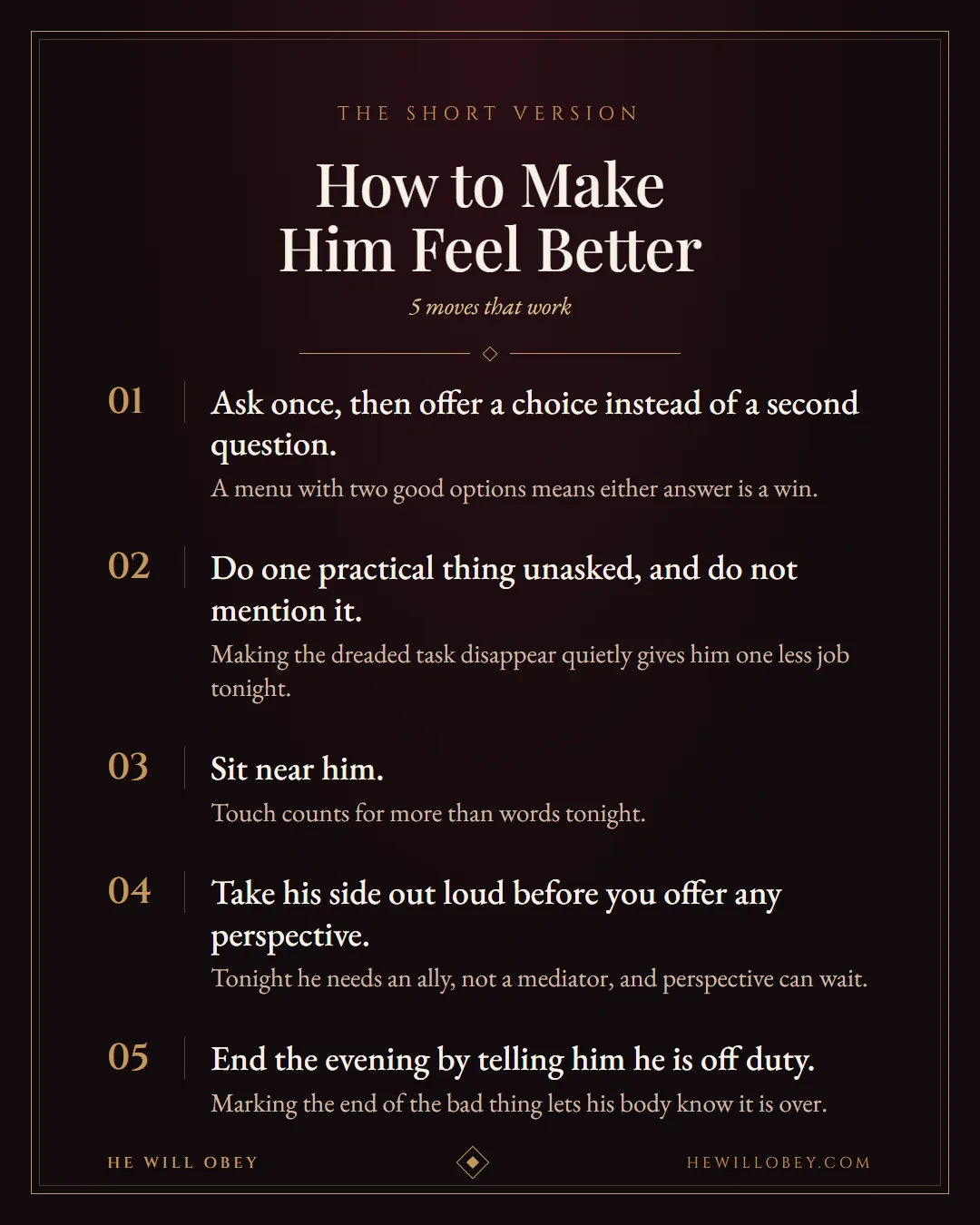
- Ask once, then offer a choice instead of a second question. A menu with two good options means either answer is a win.
- Do one practical thing unasked, and do not mention it. Making the dreaded task disappear quietly gives him one less job tonight.
- Sit near him. Touch counts for more than words tonight.
- Take his side out loud before you offer any perspective. Tonight he needs an ally, not a mediator, and perspective can wait.
- End the evening by telling him he is off duty. Marking the end of the bad thing lets his body know it is over.
Why "what's wrong?" makes it worse
He comes in, drops his keys a little too hard, says "fine" when you ask. You know it is not fine.
So you ask again. Then you ask what happened at work, whether it was his manager, whether he wants to talk, whether he is angry with you. Every question is love. To him it is an interview he did not apply for.
Now he has two jobs: carry whatever happened today, and manage your worry about it. By nine o'clock the two of you are having a small, sad argument about his tone.
Nobody is at fault. You were trying to reach him. He was trying to get through the next hour without falling apart in front of you. Many men process a hard day in silence first and in words second, if at all, and a woman who can sit inside that silence without filling it becomes the place he recovers.
In He Will Obey this is Law XIV, the Law of Aftercare: the softest moment after a hard one is when a bond sets. The book teaches it for the bedroom. It works the same way after a bad Tuesday.
Why quiet support works better than loud support
Psychologists Niall Bolger and colleagues studied couples in which one partner was preparing for the bar exam. The support that helped most was often the support the stressed partner did not notice: the dishes done, the evening kept calm, nothing announced. They called it invisible support. Support he can see, especially advice, can quietly tell him he is not coping, and that adds to the weight.
Touch does the rest. In James Coan's hand-holding study, women facing the threat of a mild shock showed less threat-related brain activity while holding their husband's hand. A hand on his back says you are not alone in this without asking him to answer.
So the method is less talk and more presence. Comfort he can see is comfort he has to respond to.
How to make him feel better: the five steps
1. Ask one question, then offer a choice. Not a second question. A menu with two items, both good. "Do you want to tell me about it, or do you want me to make you forget it for an hour?" Either answer is a win.
2. Handle one practical thing quietly. The invisible support step. Pick the task he was dreading tonight and make it disappear. Fill his car on your way back from the shops and hand him the keys without a word.
3. Sit close and say little. Sit on the same sofa cushion, not across the room. Put a hand on his knee. If you speak, keep it short. "I'm here. No rush."
4. Take his side first. When he does tell you, resist the urge to explain the other person's point of view. Tonight he needs an ally, not a mediator. "That's genuinely unfair. You did everything they asked." Perspective can come tomorrow, if he wants it.
5. Close the day softly. This is the aftercare. Mark the end of the bad thing so his body knows it is over. "You got through today. You're officially off duty. I'll run you a bath."
How to make him feel better over text
Over text, the goal is to carry presence without demanding a reply. He may be in the car park, in a meeting, or not ready to talk. A good comfort text can be read in four seconds and needs no answer.
Lines to send when you know he is struggling:
- "No need to reply. Just thinking about you and on your side, whatever happened."
- "Whatever today was, it ends at 6. Dinner is handled."
- "You don't have to be good company tonight. Come home and be grumpy next to me."
- "I'd fight your manager. Small woman, big rage. Say the word."
- "Proud of you for getting through today. That's it. That's the text."
- "Your only job this evening is to sit down. I've got the rest."
What to avoid over text, side by side:
| Instead of | Send |
|---|---|
| "What happened?? Are you ok?? Call me" | "Rough one? I'm here when you want me. No pressure." |
| "Have you tried talking to HR?" | "That sounds exhausting. You don't deserve that." |
| "Don't be sad 😢" | "Sad is allowed. Come home and be sad on my side of the sofa." |
| "Why aren't you replying?" | Nothing. Let him reply when he can. |
How to make him feel better after a bad day
A bad day needs an off switch more than a debrief. When he walks in, meet him at the door, take his bag, and give the first five minutes to his body rather than his story: food, a shower, a drink, a quiet room. Ask "do you want to talk about it" once, after he has eaten, not before.
If you want a line for after a bad day over text, the kind he might keep, try one of these: "Bad days are temporary. You are not." Or: "Today doesn't get to decide what you're worth." Short enough to be read on a train. Warm enough to be read twice.
How to make him feel better when he's sad
Sadness is slower than stress, and it does not want a solution. It wants witness. Sit with him and let the silence be long. If he talks, reflect rather than reassure: "You really loved that job." Reassurance ("you'll find a better one") is the fastest way to tell a sad man his feelings are a problem to be solved.
Distraction helps later, once he has said what he needed to. A film he loves can break the loop, and so can gentle humor; how to make him laugh has lines for that moment. If the sadness lasts weeks rather than days, help him find someone to talk to properly, and say so plainly.
The trap
The trap is making his bad day about you. You fix, because fixing quiets your own anxiety. Or you take the silence personally, and by ten o'clock he is comforting you. Either way he now has a second job when he can barely do the first.
The other trap is treating "I need some space" as rejection. Give it, warmly, and say where you will be. "I'll be in the other room. Come and find me when you're ready." Then let him come. The man who is allowed to retreat comes back sooner, and he comes back to you.
Related: how to make him less stressed.
Frequently asked questions
How to make my boyfriend feel better when he's sick?
Take the decisions off his plate. Bring the medicine, the water, the food he can stomach, and the remote, then let him sleep. Sick men often want to be looked after without being fussed over, so check in every hour or two rather than constantly. A text that says "soup is on its way, you don't have to reply" is perfect.
How to make him feel better when he's stressed?
Remove one thing from his list. Stress is a feeling of too much, so taking anything away helps more than any pep talk. Ask "what's the one thing I could take off you this week?" and then do it. Keep evenings calm and predictable until the pressure passes.
How to make him feel better after an argument?
Repair first, then comfort. Once you have both cooled down, acknowledge your part in one clean sentence, without "but." Then offer something warm and physical: a hug, his hand, sitting close. Many men feel bad long after a fight ends, and a gentle touch tells him the two of you are fine. If he is still angry, see how to make him not mad at you anymore.
How to make my husband feel better?
Notice what has been building, not just today's mood. Husbands often carry weeks of pressure quietly before it shows. Give him a night with no requests and no logistics, take one of his recurring jobs for a week, and tell him plainly that you see how hard he is working.
How to make my crush feel better?
Keep it light and low pressure. A short, kind message shows you noticed without asking for anything: "Heard your week has been rough. Hope Friday is kinder." Do not push him to open up; you have not earned that yet, and he will appreciate that you know it. Gentle attention is the best way to make him like you at this stage.
How to make him feel better after a bad day over text?
Time the text for when the bad day ends, not the middle of it, and make it one line he can read in four seconds. "Leaving work yet? Takeout is ordered. Your only job is to show up." Then put your phone down. If he replies with one word, he read it. Do not follow up asking if he is okay. That turns comfort into a task.
How to make my boyfriend feel better about not getting an apartment?
Let him be disappointed before you help him move on. He had already pictured himself in that kitchen, and losing it is a small grief. Skip "it wasn't meant to be." Say "You wanted that place, and that's annoying." Tomorrow, offer one practical thing: set up listing alerts together, or book two showings for Saturday. Hope comes back when the next step is on the calendar.
From the Codex
The Law behind this
In He Will Obey, this is Law XIV, the Law of Aftercare: the softest moment after a hard one is when a bond sets hardest, and the woman who can hold that moment calmly becomes the place he returns to. The book's ritual for it is one line, said slowly, at the end of his worst days: "It's over now. You're with me." Then nothing else.
He was never taken. He was chosen, and he knows it.
Sources
- Niall Bolger doi.org
- James Coan doi.org