How to Make Him Feel Guilty (and Why Guilt Rarely Gets You Sorry)
To make him feel guilty, show him plainly what his action did to you: one calm conversation, specific and without insults, then a visible change in what you accept. Going cold, crying at him or telling his friends works for a few days, then turns into resentment. Real guilt comes from understanding. Pressure only produces defense.
On this page
Short Version of Making Him Feel Remorse
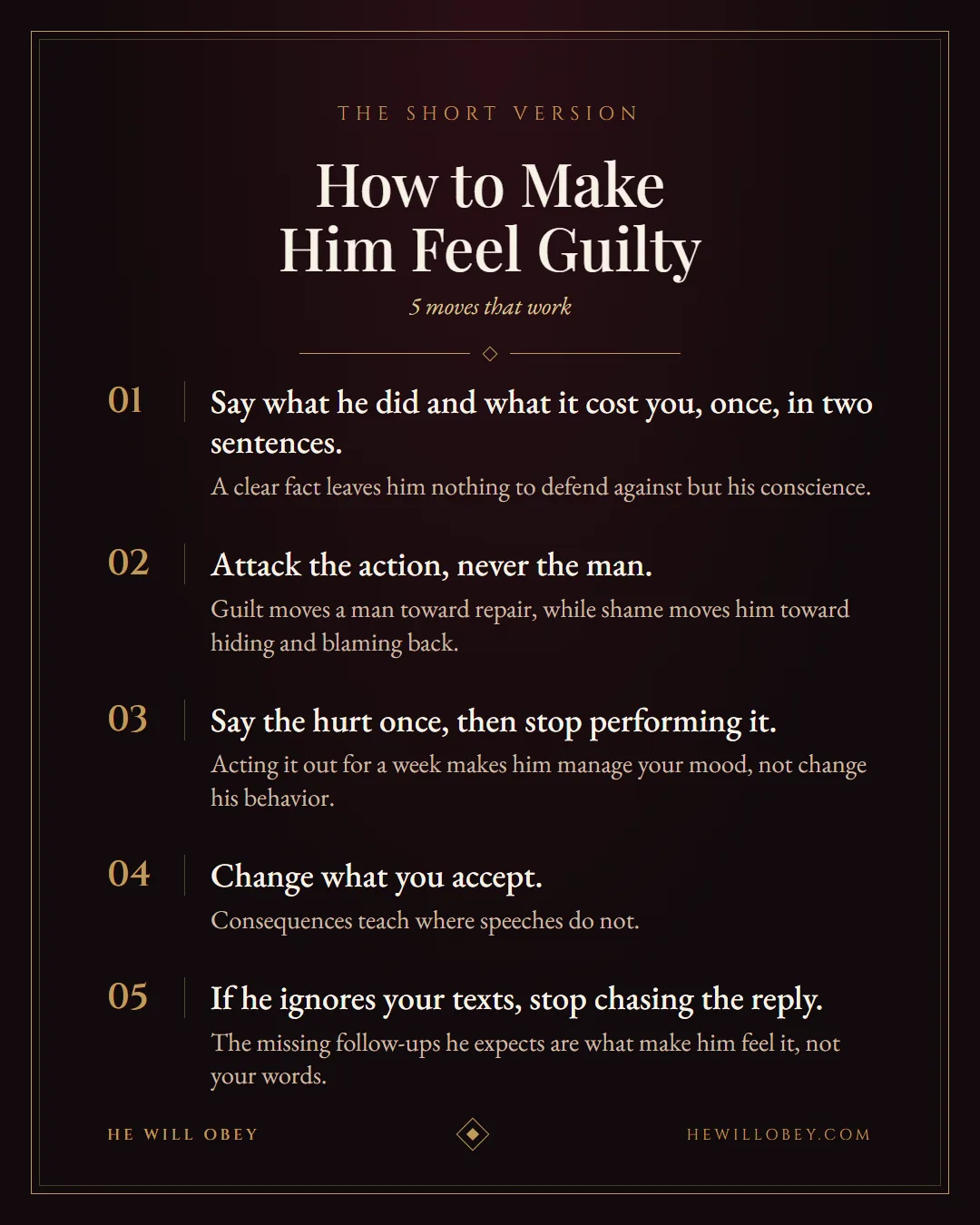
- Say what he did and what it cost you, once, in two sentences. A clear fact leaves him nothing to defend against but his conscience.
- Attack the action, never the man. Guilt moves a man toward repair, while shame moves him toward hiding and blaming back.
- Say the hurt once, then stop performing it. Acting it out for a week makes him manage your mood, not change his behavior.
- Change what you accept. Consequences teach where speeches do not.
- If he ignores your texts, stop chasing the reply. The missing follow-ups he expects are what make him feel it, not your words.
What people actually do to make him feel guilty
The usual playbook: the one-word answers. The sighs in the kitchen. Letting him find you crying. The long text at 1 a.m. listing everything he has done since March.
Telling his sister, so his sister tells him. Going silent until he asks what is wrong, and then saying "nothing."
It is not cruelty. It is what hurt people do when they feel unheard. If he will not listen to the words, maybe he will notice the weather. (Getting the apology itself is covered in how to make him forgive you and how to make him apologize.)
Why it works, for about three weeks
Some of it works, briefly. A man who sees the woman he loves upset feels a jolt of discomfort, and often he will do something to make it stop: the apology, the flowers. For a while he is attentive. It feels like the guilt landed.
Look closer at what he is sorry for, though. Usually it is not what he did. It is the atmosphere. He wants the cold front to lift, and he will say what lifts it.
What it costs you
The psychologist June Tangney, who has studied guilt and shame for decades, draws a line between the two that matters here. Guilt says I did a bad thing, and it moves people toward repair. Shame says I am a bad person, and it moves people toward hiding, defending and blaming back.
Sulking and public stories push a man toward shame, because they make the whole of him the problem. And shame does not produce apologies. It produces counterattacks.
So the bill comes in two parts. The change does not last, because he was managing your mood, not his behavior. And he learns to dread your hurt instead of responding to it. Guilt used as a leash is one of the poisons the book names, and it poisons the woman holding it too: she has to keep tightening it.
The move that gets the same result and keeps it
One conversation, one standard. This is Law III, the Law of the Throne: a queen does not campaign for better treatment, she states what she accepts and lets her life follow.
1. Name the action and its cost. Two sentences, at a calm moment. "You told me you'd be at the hospital with me and then didn't come. I sat in that waiting room on my own for three hours."
2. Stop. No speech after it. No "and another thing." Let the fact sit where he can see it. This is Law X, the Law of the Single Word: one clean sentence is heavier than ten defended ones.
3. Do not act it out afterwards. You said it. Now be normal, even warm. A man left alone with a clear fact has nothing to defend himself against except his own conscience.
4. Change what you accept. If he keeps not showing up, you stop arranging your life around his promises. You book the friend for the next appointment. That is not punishment, and you do not announce it. It is the natural consequence of his unreliability, and consequences turn guilt into change.
How to make him feel guilty for ignoring you through text
He has left you on read since Thursday. You can see he has been online. Every instinct says to send something that will make him feel it: a cold "Glad you're alive," or a long paragraph about respect.
Any of those casts him as the man being nagged. Send one calm line that names it, then go quiet. "I've noticed you go silent when things get busy. I'm not going to chase it. Message me when you're around."
Then do exactly that. Put the phone in a drawer and live your weekend.
What makes him feel it is not your words. It is the absence of the follow-ups he has learned to expect. When he surfaces, be pleasant, not punishing. If ignoring you has become a pattern rather than a bad week, the guide to make him regret ignoring you goes further.
The trap
The trap is the guilt campaign. He apologized, but it was not enough, so you raise it again on Tuesday, and again in the car. You want him to feel it as much as you did. He never will. A man hurt on purpose stops feeling guilty and starts feeling wronged.
Say it once. Hold the standard. Let his behavior answer, or not.
One more line, plainly: if his silences are used to punish you, if you find yourself apologizing to end them, or if you feel afraid of how he will react, that is not a texting problem. It is a pattern of control. In the US, the National Domestic Violence Hotline is 1-800-799-7233. In the UK, the National Domestic Abuse Helpline is 0808 2000 247.
Frequently asked questions
How to make him feel sorry for hurting you?
Tell him, once and calmly, exactly what he did and how it landed. "When you laughed at me in front of them, I felt humiliated." Then stop talking and let him think. Lasting sorry comes from seeing the effect, not from punishment.
How to make him feel sorry for not treating you right?
Stop explaining how you deserve to be treated and start choosing it. Say once what you will no longer accept, then follow through without fuss: leave when he is rude, stop waiting for the call he promised. A man notices what he loses faster than what he is told.
How to make him feel sorry for you?
You can, but pity is a weak lever: comfort for a night, nothing changed next week. What you usually want is respect, him understanding that something hurt you and not doing it again. Ask for that directly.
How to make my boyfriend feel guilty for ignoring me?
Send one calm message that names the pattern, then stop chasing. No double texts, no screenshots, no sulking when he resurfaces. His guilt comes from noticing you stopped waiting. Frequent days of silence are information, not a puzzle for you to solve.
How to make my boyfriend feel sorry for me?
If you mean you want him to understand how hard things have been, tell him directly and ask for what you need. "This week has flattened me. I need you to come over tonight." A clear request gets more care than hoping he picks up the signals.
How to make him feel guilty for ignoring you through text after a fight?
Do not send the guilt text. After a fight, silence can be him cooling down. Wait a day, then send one line that keeps the door open without begging. "I'm still upset, and I still want to sort this. Let me know when you're ready." Then leave it.
From the Codex
The Law behind this
In He Will Obey, this is Law III, the Law of the Throne: you do not plead for better treatment or punish him into it. You decide what you accept, say it once, and let your life follow. Guilt fades. A standard stays. The book gives you the full Law, the chapter on guilt as a leash so you can spot it aimed at you, and the Phrasebook lines for naming a hurt without a fight.
He was never taken. He was chosen, and he knows it.
Sources
- June Tangney doi.org