How to Make Him Open Up (About His Feelings, Not Just His Day)
To make him open up, go first: share something small and true about yourself, then give him room to match it. Swap "how do you feel?" for a question with two answers he can pick from. Let "not now" be a fine reply. Openness grows by trading, a little at a time, and it grows fastest when nothing is demanded.
On this page
Short Version of Getting Him to Share His Feelings
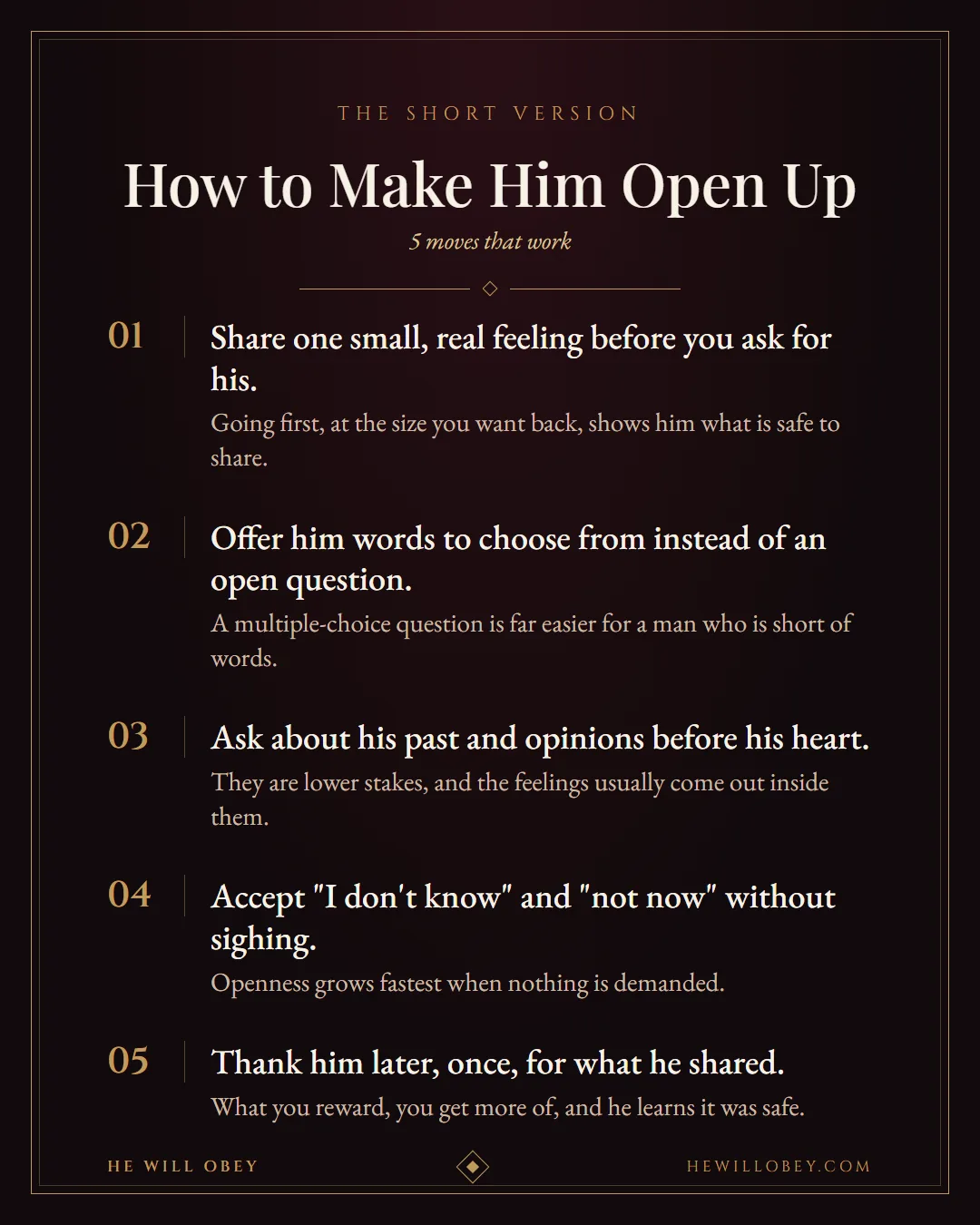
- Share one small, real feeling before you ask for his. Going first, at the size you want back, shows him what is safe to share.
- Offer him words to choose from instead of an open question. A multiple-choice question is far easier for a man who is short of words.
- Ask about his past and opinions before his heart. They are lower stakes, and the feelings usually come out inside them.
- Accept "I don't know" and "not now" without sighing. Openness grows fastest when nothing is demanded.
- Thank him later, once, for what he shared. What you reward, you get more of, and he learns it was safe.
Why he closes up when you ask
You ask how he feels about his dad's diagnosis. He says "it is what it is" and gets up to check the oven. You ask again in bed, because it is dark and quiet and surely now, and he says he is tired.
It feels like a locked door. Often it is something simpler: he does not have the words ready. Many men were raised in homes where feelings were handled by not discussing them, and "how do you feel?" lands like a question in a language he only half speaks.
Trust is the ground all of this stands on, and the pillar on how to make him trust you builds that part. This page is about the next step: helping a man who trusts you say what is inside.
The psychology: he matches what you bring
The psychologist Sidney Jourard spent years studying self-disclosure and found that it tends to be reciprocal. When one person shares something personal, the other is likely to share something of similar depth back. Disclosure is a trade. If you only ask, he has nothing to match.
The second piece has a name too. Ronald Levant described what he called normative male alexithymia: many men, because of how they were raised, struggle to identify and put words to their own feelings. The feelings are there. The vocabulary and the practice are not.
So put something of yours on the table first. Then make the words easier to find.
In He Will Obey this is Law XII, the Law of the Asked Question: a question that leaves room for every answer, including no, gets more honest answers than one that demands a particular one.
How to make him open up: the five steps
1. Go first, and keep it small. Share a real feeling of your own, at the size you want back. Not your childhood. Something from this week. "I've been dreading my review all week, and I haven't said it to anyone till now."
2. Give him words to choose from. A multiple-choice question is far easier than an open one for a man who is short of words. "Is the thing with your dad more of a worry, or more of a sadness?"
3. Start with his past and his opinions. These are lower stakes than his heart, and the feelings usually come out inside them. "What was your grandad like when you were small? You never talk about him."
4. Let "not now" be a good answer. If he says he does not want to talk, believe him and mean it. That is the asked question in its purest form. "Okay. Offer stands. I'm not going anywhere."
5. Thank him later, once. The next day, mention what he shared, briefly and warmly. That is Law VIII, the Law of the Golden Word: what you reward, you get more of. "Thank you for last night, the bit about your brother. That took guts."
How to make him express his feelings
To make him express his feelings, ask about what happened and let the feeling arrive on its own. Men often say how they feel inside a story long before they say it as a sentence. The guide on how to make him talk to you has more on getting the story started.
Then catch the feeling when it shows and hand it back to him as a guess, not a verdict. "Sounds like that really stung." If you are wrong, he will correct you, and the correction is him expressing it. If he is trying to tell you something bigger about how he feels about you, that is a different conversation, covered on how to make him confess his feelings.
The day after he opens up
Expect a pullback. After a man says something real for the first time, he may be quieter or gruffer the next day. Brené Brown calls this a vulnerability hangover, and it is normal.
Do not chase it with "are we okay?" Be ordinary and warm. The message he needs is that nothing changed, except that you know him a little better now.
The trap
The trap is the feelings interview. You sit him down, face to face, and ask him to open up. He freezes, you push, he says something flat to end it, and you both come away feeling worse.
The second trap is using it. You bring what he told you into a fight, or tease him about it in company. One time is enough. A man who sees his opened door used against him locks it for a long while, and he is right to.
Frequently asked questions
How to make him admit his feelings?
Make admitting them cost nothing. Share a small feeling of your own first, so he is not the only one exposed, and react calmly when he does say something. Do not push for a declaration. A man admits what he feels once he is sure your reaction will be kind, and once the moment is quiet enough to hear it.
How to make him open up to you?
Trade, do not interview. Tell him something small and true about your week, then leave a pause long enough for him to match it. Talk while you walk or drive rather than across a table. When he does share, receive it quietly, and thank him once the next day. Openness repeats when it feels safe.
How to make him vulnerable?
You cannot make a man vulnerable, and trying to force it usually backfires. You can make vulnerability safe: go first with your own, and never use what he shares against him. Some men need months. If he says something real, even small, treat it as the gift it is.
How to make my boyfriend emotionally available?
Look at whether he is unavailable or just unpracticed. An unpracticed boyfriend responds slowly to small trades, multiple-choice questions and patience. An unavailable one keeps you at a distance on purpose, dodges any future plans and goes cold when you get close. You can help the first. The second is information, and the guide on how to make him feel comfortable with you is a fair test of which one he is.
How to make my boyfriend more emotionally intelligent?
Give him the vocabulary without the lecture. Name your own feelings precisely in everyday talk, "I'm not angry, I'm disappointed," and offer him choices when he is stuck. Notice when he reads you well and say so. Emotional skill grows with practice, and many men simply never had any.
How to make my boyfriend open up to me over text?
Text can be easier for some men, because nobody is watching their face. Ask one specific question rather than "what's up," and share something of your own in the same message. Do not send three follow-ups if he goes quiet.
From the Codex
The Law behind this
In He Will Obey, this is Law XII, the Law of the Asked Question: ask in a way that leaves room for every answer, and you will hear the true one. The book gives you the ritual for building a question that does not corner him, and the lines for the morning after he finally says it.
He was never taken. He was chosen, and he knows it.
Sources
- Sidney Jourard doi.org
- Ronald Levant doi.org
- Brené Brown www.ted.com