How to Make Him Pay Attention to You (When His Eyes Keep Drifting to the Phone)
To make him pay attention to you, stop competing for it and start asking for it plainly, at a set time, for something worth hearing. Change one thing he has stopped seeing, and reward every moment he turns toward you. A man's attention goes where something is new and where it is welcomed. Right now, neither describes you.
On this page
Short Version of Getting His Full Attention
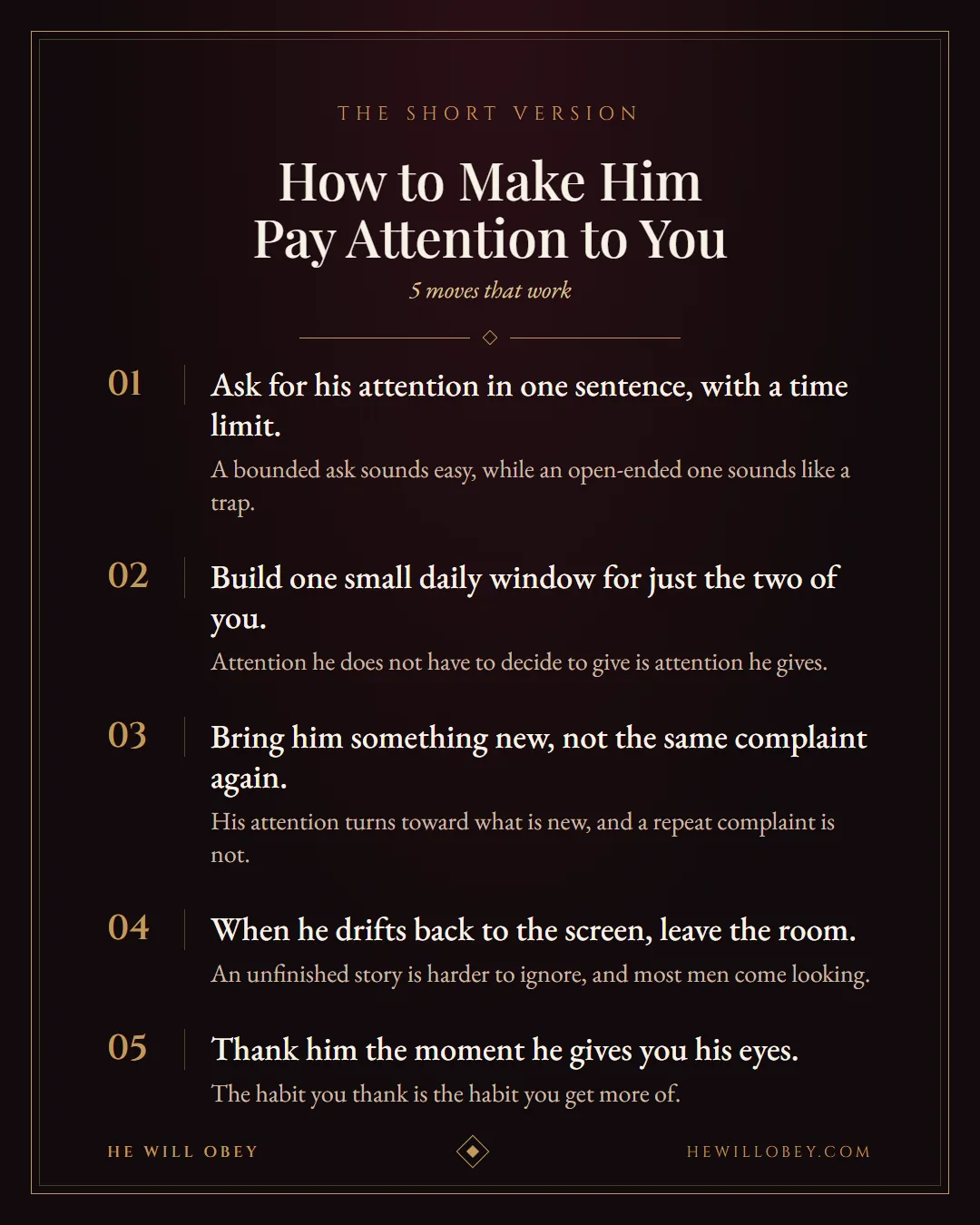
- Ask for his attention in one sentence, with a time limit. A bounded ask sounds easy, while an open-ended one sounds like a trap.
- Build one small daily window for just the two of you. Attention he does not have to decide to give is attention he gives.
- Bring him something new, not the same complaint again. His attention turns toward what is new, and a repeat complaint is not.
- When he drifts back to the screen, leave the room. An unfinished story is harder to ignore, and most men come looking.
- Thank him the moment he gives you his eyes. The habit you thank is the habit you get more of.
Why he stopped paying attention
You are halfway through the story about your manager. He says "mm" at the right moments. His thumb is still moving. You stop, and he does not notice you stopped. You say "Are you even listening?" and he repeats your last four words back to you, which is technically listening and not what you meant.
You are not boring. You are constant. Same voice, same chair, same hour. His brain has filed you under things that are always there, and the phone keeps throwing up things that are not.
The bigger picture, the invisible work and the slow fade into the furniture, is in the main guide on how to make him appreciate you. This page is narrower: his eyes, now.
The psychology: the brain turns toward change
Ivan Pavlov noticed that his dogs stopped mid-task and turned toward any new sound. He called it the "what is it?" reflex. Psychologists now call it the orienting response: attention snaps toward anything that changes and slides off anything that does not. A ticking clock disappears within minutes. Stop it and everyone looks up.
The phone is built to fire the orienting response all evening. You cannot out-novelty it. You can stop being the ticking clock.
There is also real research on what the phone costs couples. James Roberts and Meredith David at Baylor University studied partner phubbing, being snubbed for a phone, and found it linked to more conflict and lower satisfaction in the relationship. You are not imagining that it matters.
How to make him pay attention to you: the five moves
1. Ask for it plainly, with edges. An open-ended demand for attention sounds like a trap with no exit. A bounded one sounds easy. "Give me fifteen minutes, phone in the kitchen. I've got news and I want your face for it." Short, warm, and it assumes yes.
2. Build a small daily window. In He Will Obey this is Law XI, the Law of Devotion Rituals: small daily acts that train the bond. Pick one slot, ten or twenty minutes, same time each day. Coffee on the back step before work. The walk after dinner. The bath he sits beside. A ritual removes the negotiation. Attention he does not have to decide to give is attention he gives.
3. Bring him something new. New does not mean dramatic. A question he has never been asked. "What's a job you'd have been brilliant at if you'd never met a computer?" A thing you learned this week. A plan he did not see coming. The orienting response works for you too, once you give it something to orient toward.
4. When he drifts, leave. He picks up the phone mid-sentence. You do not repeat yourself louder. You smile, say "I'll finish that later," and go do something you enjoy in another room. This is Law IV, the Law of Withdrawn Light, used gently. Your attention was on offer. He passed. It moved on. Most men come looking within the hour, because an unfinished story is harder to ignore than a finished one.
5. Reward the turn. The moment he puts the phone face down and looks at you, say so. "I like this. You, listening, with that face." Law VIII, the Law of the Golden Word. The habit you thank is the habit you get more of.
How to make him crave your attention (and beg for it again)
What most women do here is take their attention away hard. Short answers. A cool face. Laughing at someone else's jokes. Leaving him on read on purpose.
And it works, for a while. Attention that was guaranteed and suddenly is not becomes very visible, and he will lean in to get it back.
It costs more than it looks. He learns that your warmth is a lever you pull, and he starts guarding against it. A man who has to beg for attention for weeks does not crave you. He resents the toll.
The move that keeps the craving is simpler. Make your attention generous and specific when you give it, and unavailable when it is not being received. Full eye contact, real questions and laughter when he is with you. Absent, warmly and without comment, when he is scrolling.
He will crave what is clearly good and clearly not on tap, and he will not resent it, because nobody took anything from him. "Go finish your game. I'll be on the balcony with the good wine."
The trap
The trap is the attention audit. You start counting. How many times he looked at his phone during dinner. How long he took to answer. How he paid more attention to his brother's story than yours.
Then you present the count. "Do you know you checked your phone eleven times?" Every number is accurate. Every number makes the next hour with you feel like a performance review, and men give those as little attention as they can.
The second trap is the crisis bid: getting his attention with distress because distress is the only thing that reliably works. It does work. It also teaches him that your attention requests are emergencies, and he starts to brace whenever you say his name. Ask for the good stuff, out loud, while things are fine.
Free tool: Take the free quiz: is he losing interest?.
Frequently asked questions
How to make my boyfriend give me more attention?
Ask for one specific form of it, not more in general. "Saturday mornings, phones off till eleven." Vague requests for more attention sound like a test he cannot pass. A specific one sounds like a plan. Thank him the first few times he keeps it, and keep plans of your own for the rest of the week.
How to make my boyfriend pay more attention to me?
Make the time you spend together less predictable and more yours. Change where you sit, what you do, what you talk about. Then, when he does focus on you, tell him what it did for you. Men repeat attention that is noticed. They drop attention that gets met with "finally."
How to make my husband give me attention?
Put it in the calendar, without embarrassment. Long marriages lose attention to logistics, and logistics win every time unless something is scheduled against them. Twenty minutes after the children are in bed, no screens, one question that is not about the household. Small and fixed beats grand and rare. How to make him stop taking you for granted covers the wider pattern.
How to make him give you attention over text?
Send less, and make it about something he cares about. A photo of the trail he recommended. A question about the match. Texts that are only about wanting attention get the least of it. Texts with something in them get answered, and answered texts are attention.
How to make him pay attention when he's always on his phone?
Agree on phone-free times together instead of policing the phone. Meals and the first ten minutes after you both get home are a fair start. If he keeps reaching for it, leave the table warmly. The empty chair says it better than you can.
Is it needy to want his attention?
No. Wanting your partner's attention is normal and healthy. It turns needy when the request becomes constant, vague or angry. One clear ask, a ritual that protects it, and a life of your own outside it is not needy. It is a woman who knows what she wants and says so. If you are new to him and want to be noticed in the first place, see how to make him notice you.
From the Codex
The Law behind this
In He Will Obey, this is Law XI, the Law of Devotion Rituals: small daily acts that train the bond. Attention fought for every night runs out. Attention with a home, same ten minutes, phone in the other room, becomes a habit he would miss. The book gives you the seven-day ritual for building that window, the Devotion Menu of small acts to put inside it, and the Golden Word lines that keep him coming back to it.
He was never taken. He was chosen, and he knows it.
Sources
- Ivan Pavlov doi.org
- James Roberts and Meredith David doi.org