How to Make Him Spend Money on You (Generosity, Not a Deal)
To make him spend money on you, let his generosity land: say yes when he offers, thank him for the specific thing, and stop paying for what he would gladly cover. A man spends where his giving is visibly enjoyed. Never make affection the price. If the money is shared, it is a conversation, not a tactic.
On this page
Short Version of Getting Him to Spend on You
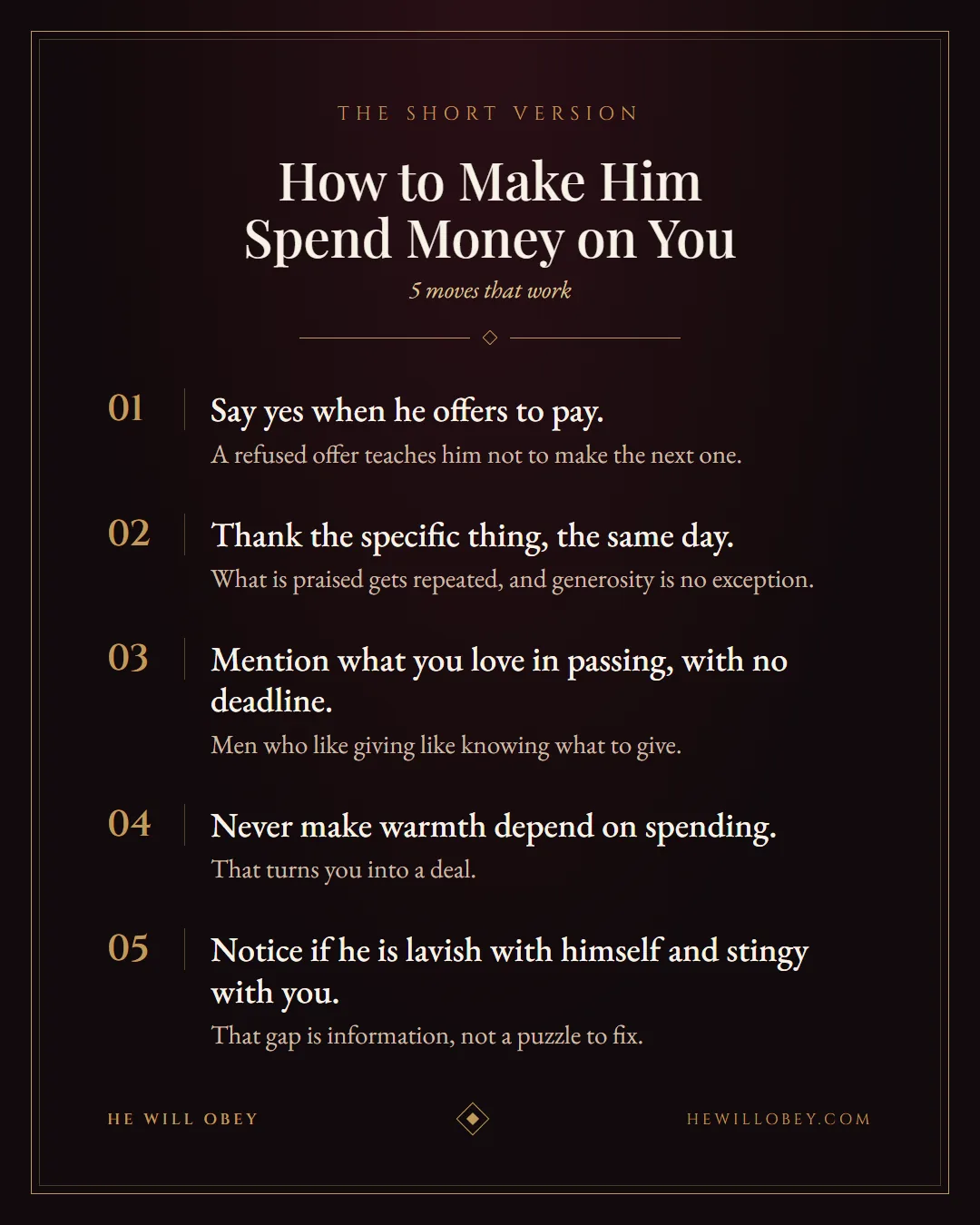
- Say yes when he offers to pay. A refused offer teaches him not to make the next one.
- Thank the specific thing, the same day. What is praised gets repeated, and generosity is no exception.
- Mention what you love in passing, with no deadline. Men who like giving like knowing what to give.
- Never make warmth depend on spending. That turns you into a deal.
- Notice if he is lavish with himself and stingy with you. That gap is information, not a puzzle to fix.
Why he does not spend on you
There are three versions of this, and they need different answers.
In the first, you trained it out of him. You split every bill to the penny from the first date, because you did not want to look like that kind of woman. When he brought flowers you said "oh, you didn't need to," and meant it as modesty. He heard it as a no. A man who is turned down twice stops offering.
In the second, he simply does not have it. Generosity on a tight income looks like the drive to fetch you and the meal he cooks. Read the effort, not the receipt.
In the third, he has it and spends it on himself. The golf weekend, the new phone, and a shrug when your birthday comes. That one is not a training problem.
The pillar on how to make him change gives the general rule: change what you accept, not who he is. With money, the first version is the common one, and the most fixable.
The psychology: give, or keep score
The psychologists Margaret Clark and Judson Mills drew a line between two kinds of relationship. In an exchange relationship, every benefit creates a debt, and people expect quick repayment: a business deal, or a colleague who covered your shift. In a communal relationship, people give because the other person's needs and pleasure matter to them, and they do not count. Their research found that keeping score inside a close bond, paying back at once, itemising, makes it feel cooler and more like a deal.
Both of the usual mistakes are exchange behavior. Paying him back for every coffee tells him the relationship runs on accounts. So does the opposite: warmth when he spends, a chill when he does not. A man spends freely in a communal bond, because there your pleasure is the reward.
How to make him spend money on you: the five moves
1. Say yes to the offer. When he reaches for the bill, let him. No arm wrestle over the card machine. "Thank you. Next coffee's on me." That last half is not a repayment. It is two people taking turns because they like each other.
2. Thank the specific thing. Not "thanks for everything." The thing. "That bookshop voucher was so you. I've already picked the first one." This is Law VIII, the Law of the Golden Word: what is praised gets repeated, and generosity is no exception. The full art of it is on how to make him feel appreciated.
3. Let your pleasures be visible. Mention what you love when you love it, not three days before your birthday as a hint with a deadline. "I could live in this shop. Look at the glaze on that bowl." He files it. Men who like giving like knowing what to give.
4. Stop covering what is his. If you have been paying his share of the rent, his phone bill, his half of every holiday because it was easier than the conversation, stop quietly. Not to punish him. Because generosity cannot grow toward you while money flows the other way without a word.
5. Let him invest. This is Law V, the Law of Investment: a man values what he has put something into. Let him plan and pay for the weekend away, and enjoy it out loud. He will want to protect what he built.
If you share money with him
When you live together or are married, "make him spend money on me" or "give me money" is usually a household question, and household questions are answered on paper, not with tactics.
Sit down on a quiet Sunday with a notebook and both incomes. Who pays for what. What goes into a joint pot.
What each of you has to spend without asking, because every adult needs some money that is simply theirs. "I'd like us both to have a set amount each month that's ours, no questions. What feels fair?"
This matters most if you are at home with children, or earn much less. Being without money of your own is not a romantic issue. It is a practical one, and it is fair to ask for a share by right, not as a favor.
One hard line. If he controls all the money, makes you ask for every purchase, takes your wages, or keeps you from working, that is financial control, and it is a recognized form of abuse. A helpline can talk it through with you even if you are unsure: in the US 1-800-799-7233, in the UK 0808 2000 247.
The trap: becoming the deal
The trap is the transaction. Sulking after the cheap present. Warmer on the nights he pays. Hints that harden into demands. Comparing his gifts to what your friend's man bought.
It can work, briefly. He spends to get the warm version of you back. But he has learned the warmth costs money, and men who pay for warmth start keeping receipts. Within a year he spends with a sigh and brings up the bag in the next argument. Worse, you can no longer tell whether he loves you or is paying a fee.
Spending that is extracted is resented. Spending that is invited is enjoyed. Only the second one keeps coming.
Frequently asked questions
How to make him spend money on you psychology?
The psychology is simple: people repeat what feels rewarding. When his gift is visibly enjoyed and thanked specifically, giving becomes pleasurable, and he gives again. When it is refused, or expected as payment for affection, the pleasure goes. Clark and Mills's work on communal relationships explains why scorekeeping kills generosity in a close bond.
How to make him spend on you without asking?
Let him know you, then let him give. Mention what you love in passing, accept offers gracefully, and thank him specifically when he spends. Most men who are spoken to this way start offering on their own. If he never spends on you, but spends freely on himself, that is not a hint problem. It is how he values you.
How to make my boyfriend give me money without asking?
If you mean a boyfriend who covers dates and gifts unprompted, accept and thank him well and he will offer more often. If you mean regular money, that is a conversation, not something to arrange without asking. Unspoken money arrangements tend to breed resentment on one side and dependence on the other.
How to make my husband give me money?
Ask for a fair, regular share as a household decision, not a favor. Lay out both incomes, agree the bills, and agree a personal amount each of you has without justifying it. If he refuses to discuss money, controls every purchase, or keeps you from working, that is financial control. A domestic abuse helpline can help you think it through.
How to make my man spend money on me?
Make his generosity a pleasure to give. Say yes when he offers, thank him for the particular thing, and stop insisting on paying him back for everything. Let him plan and pay for something now and then, and enjoy it out loud. Never trade affection for spending. Generosity that is bought stops being generosity.
How to make my boyfriend spend money on me?
Stop refusing his offers, then notice how often he makes them. If you have split everything from the start, say so gently. "You don't always have to let me pay half, you know." If he still never spends on you while spending freely elsewhere, that is worth knowing early. It rarely changes after the wedding. The page on how to make him stop taking you for granted covers the wider pattern.
From the Codex
The Law behind this
In He Will Obey, this is Law V, the Law of Investment: let him build what he will protect. A man treasures the woman he has put himself into, his time and yes, his money, given freely and enjoyed openly. The book gives you the full Law, the ritual for receiving well, and the Golden Word scripts that make giving its own reward.
He was never taken. He was chosen, and he knows it.
Sources
- Margaret Clark and Judson Mills doi.org