How to Make Him Think About You (Long After You've Left the Room)
The mind replays what it has not finished. To make him think about you, leave him something open: end the conversation at its best moment, tell half the story and save the rest, and give him one question to answer later. A man thinks about the woman he has not fully figured out, not the one who explained everything.
On this page
Short Version of Staying on His Mind
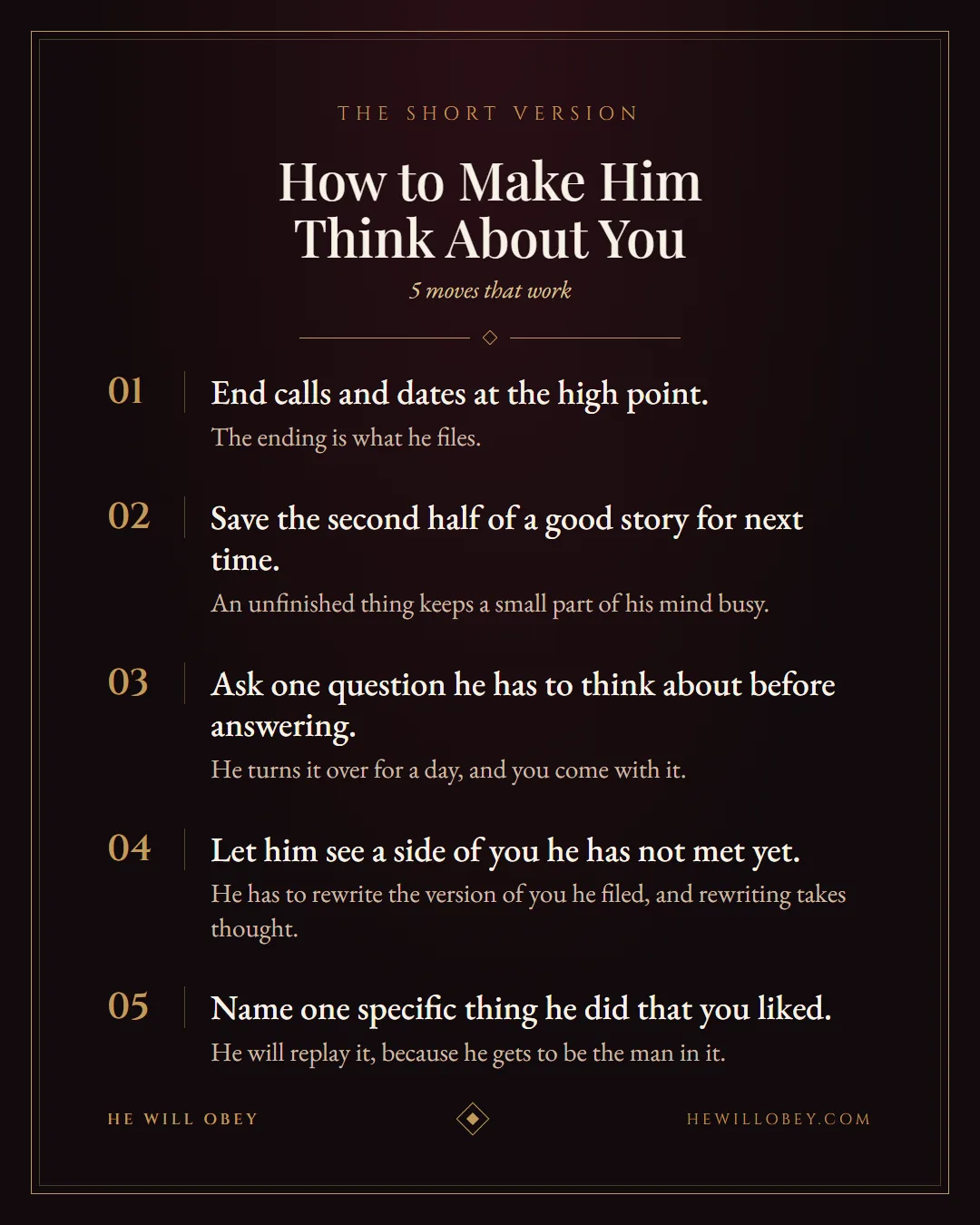
- End calls and dates at the high point. The ending is what he files.
- Save the second half of a good story for next time. An unfinished thing keeps a small part of his mind busy.
- Ask one question he has to think about before answering. He turns it over for a day, and you come with it.
- Let him see a side of you he has not met yet. He has to rewrite the version of you he filed, and rewriting takes thought.
- Name one specific thing he did that you liked. He will replay it, because he gets to be the man in it.
Why he isn't thinking about you (yet)
You told him everything on the second date. The job you are thinking of leaving, the ex who moved to Leeds, the thing with your dad. When he texts a question, you answer it, then answer the follow-up he has not asked, then send a voice note explaining the follow-up. By Sunday night there is nothing left about you for him to wonder about.
So his mind goes where minds go: to the next unfinished thing. The work email he has not answered. The match on Saturday.
Thought is drawn to loose ends. You tied all of yours.
You did it because being known feels like being close, and it is. It is just not what keeps him awake at midnight going back over something you said.
The psychology of making him think about you
He thinks about what is unfinished, and he remembers how things end. Both have names.
The Zeigarnik effect. In the 1920s Bluma Zeigarnik, working in Kurt Lewin's lab in Berlin, found that people remember tasks they were interrupted in far better than tasks they completed. An unfinished thing keeps a small part of the mind busy. It is why a TV cliffhanger works and why a song cut off mid-chorus plays in your head all afternoon.
The peak-end rule. Daniel Kahneman found that people judge an experience mostly by its most intense moment and by how it ended, not by its average. Two hours of a good date matter less to his memory than the best ten seconds and the last minute.
Neither one needs a game. They need you to stop finishing everything for him. In He Will Obey this is Law I, the Law of the Closed Door: mystery without lies. You never hide who you are. You just do not hand all of it over in one sitting.
How to make him think about you: the five moves
1. Stop at the high point. When the call is at its funniest, go. When the date is at its warmest, get your coat. The ending is what he files. "Okay, I'm hanging up before you ruin this."
2. Tell half the story. The weekend in Lisbon where everything went wrong had two disasters. Tell him the first. Let the second wait. "Remind me to tell you what happened with the ferry. It gets worse." He will remind you.
3. Ask the question that takes a day. Not "how was your day." Something he has to turn over before he answers, and tell him not to answer yet. "What's something you were certain of at twenty that you've completely changed your mind on? Don't answer now. Tell me Friday."
4. Let him meet a new side of you. The night he hears you speak fluent Portuguese to your grandmother on the phone, or watches you take apart a flat-pack wardrobe without the instructions, he has to rewrite the version of you he had filed away. Rewriting takes thought. "Come to the quiz on Thursday. I'm unbearable at geography."
5. Hand him a specific memory of himself. General compliments slide off. Precise ones get replayed, because he gets to be the man in them. "The way you handled that waiter tonight. Calm, funny, firm. I liked watching that." This is Law VIII, the Law of the Golden Word, and it works because it is true.
How to make him think about you over text
Over text, he thinks about you when a thread is left open, not when it is closed politely.
End on something unfinished. A question, a plan you have half made, a story you started. "Something ridiculous happened on my way in. Tell you tonight."
Sent at 8 a.m., that one line keeps a small door open in his head until evening. That is how you get him thinking about you all day without texting him all day.
Twenty texts a day close every loop as fast as he opens it. One good one leaves something hanging.
What not to send: "thinking about you." It tells him what is happening in your head, not his. It closes the loop it was meant to open.
The trap
The trap is mistaking a locked door for a closed one.
Mystery without lies means you are open and unhurried. Mystery with lies is the vague answer to a simple question, the "wouldn't you like to know," the two-day disappearance with no explanation, the cryptic story posted at midnight. He will think about that once, decide it is a game, and either play it back or leave.
The second trap is the loop you never close. If you promised him the ferry story, tell him the ferry story. An open loop that stays open for weeks stops being intriguing and starts feeling like a tease, and a man who feels teased stops trusting the next thing you start. Close every loop you open. Just not on the same night.
Frequently asked questions
How to make him think about me all day?
Open a loop in the morning and close it at night. One text at breakfast that promises something later: a story, a photo, a question. Then go about your day and do not text again until evening. He carries the unfinished thing through his afternoon, which is the Zeigarnik effect doing the work for you.
How to make him think about you all the time psychology?
No one thinks about anyone all the time, and you would not want a man who did. The psychology is narrower: unfinished things stay on the mind (the Zeigarnik effect), and he remembers your best moment and your exit (the peak-end rule). Control those two and you take up more of his thoughts than any amount of contact.
How to make him think about you during no contact?
Let the last contact be a good one, then go quiet for real. No contact is the ultimate unfinished ending, and an ending that was warm and unexplained stays on his mind longer than one that ended in a row. Do not watch his stories. For the full version, read how to make him miss you during no contact.
How to make my ex think about me constantly?
You cannot make anyone think about you constantly, and trying is how women end up posting for an audience of one. What you can do is stop being predictable to him. Go quiet, leave his last memory of you calm rather than tearful, and change your life in ways he only hears about secondhand.
How to make my crush think about me?
Leave the conversation first, at a high point, with a joke only the two of you got. "I'm off. Save your pineapple-on-pizza defense for next time." Then do not follow up that day. He replays the last line and the laugh, and wonders when the next one is coming.
How to make my boyfriend think about me?
Leave something of yours at his place, show him a side of you he has not seen in a while, and praise one specific thing he did this week. Boyfriends stop thinking about you when they know exactly what every evening with you holds. Change one evening.
How to make him think about you more?
Fewer, better moments. Cut the texts that report and keep the ones that open something. End things earlier than feels natural. The more you finish for him, the less of him is left wondering. If you want the stronger version of this pull, see how to make him obsessed with you.
From the Codex
The Law behind this
In He Will Obey, this is Law I, the Law of the Closed Door: mystery without lies. A man thinks about the woman he has not finished reading, and you decide how fast he turns the pages. The book gives you the seven-day ritual for it, the lines for leaving a conversation at its peak, and what to say when he asks why you never tell him everything at once.
He was never taken. He was chosen, and he knows it.
Sources
- Bluma Zeigarnik doi.org
- Daniel Kahneman doi.org