How to Make Him Calm Down (When He Is Angry or Wound Up)
To make him calm down, slow yourself down first. Drop your voice and say one line that shows you heard what he is angry about. Then stop talking and let his body settle before anyone tries to solve anything. Calm is catching. So is panic. He will match whichever one you bring.
On this page
- Short Version of Helping Him Settle Down
- Why everything you say makes it worse
- The psychology: calm is catching
- How to make him calm down: the five steps
- How to make him relax after work
- How to make him not be mad at you
- If he's your boyfriend
- When his anger is not a calming problem
- The trap
- Frequently asked questions
Short Version of Helping Him Settle Down
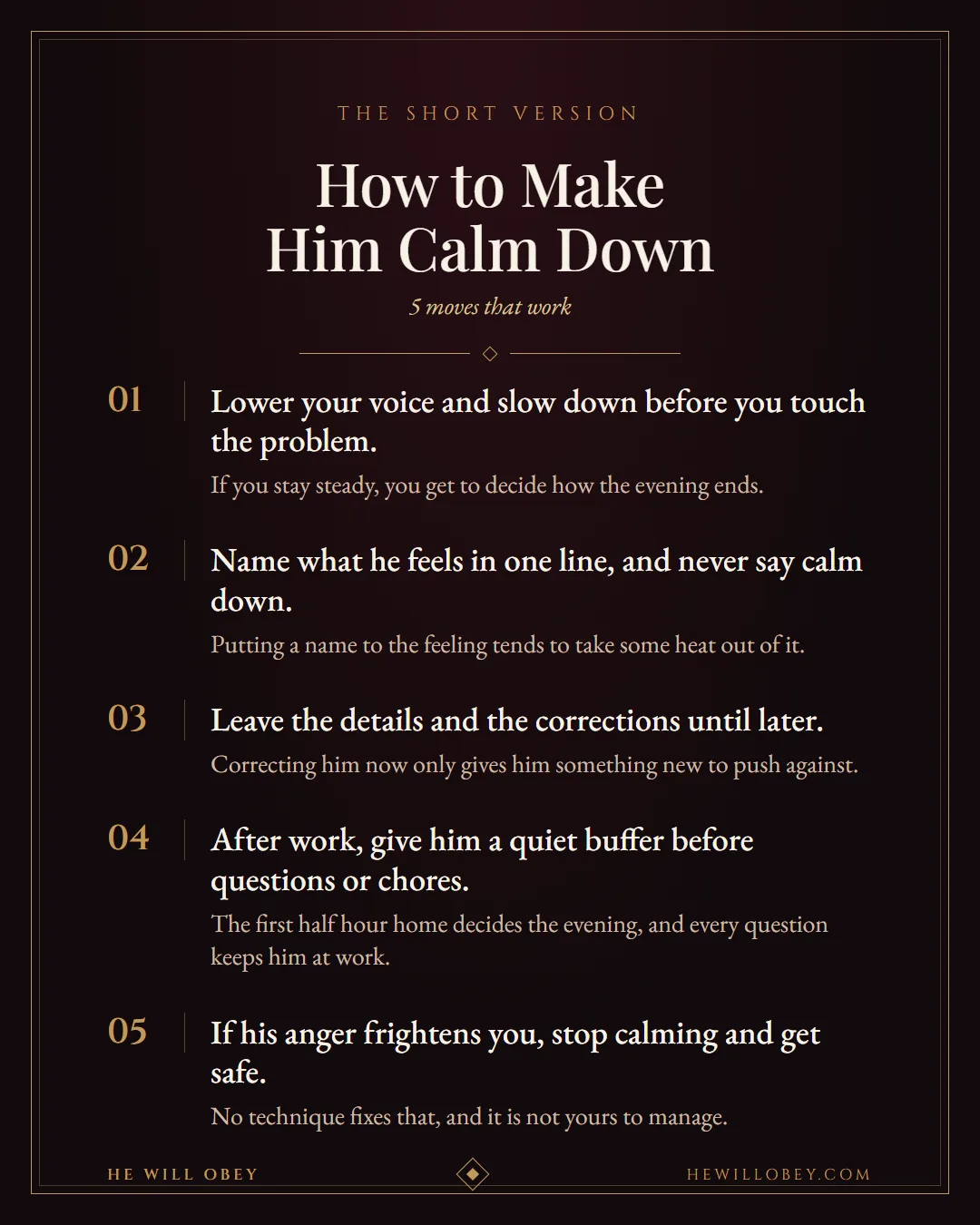
- Lower your voice and slow down before you touch the problem. If you stay steady, you get to decide how the evening ends.
- Name what he feels in one line, and never say calm down. Putting a name to the feeling tends to take some heat out of it.
- Leave the details and the corrections until later. Correcting him now only gives him something new to push against.
- After work, give him a quiet buffer before questions or chores. The first half hour home decides the evening, and every question keeps him at work.
- If his anger frightens you, stop calming and get safe. No technique fixes that, and it is not yours to manage.
Why everything you say makes it worse
He is pacing the kitchen about the landlord, the deposit, the email that came at 6 p.m. His voice climbs. You answer fast, because silence feels dangerous. You explain. You correct the date he got wrong.
Eventually you say "calm down," and he gets louder, because nobody has ever calmed down on hearing those words.
Every sentence was reasonable. Speed was the problem. A wound-up man reads your tone long before he hears your words, and a quick, tight voice tells him the fight is still on.
This page is about ordinary anger: the slammed cupboard, the rant about work. If he is angry with you for something you did, the repair steps are on how to make him not mad at you; calm comes first either way.
If his anger scares you, go straight to the section near the end. That is a different problem.
The psychology: calm is catching
The psychologist Elaine Hatfield and her colleagues called it emotional contagion. People unconsciously mirror the faces, voices and posture around them, and catch the feelings that come attached. Match his volume and you feed it. Hold a slower, lower register and, without deciding to, he starts to match you.
Rena Repetti found something useful in her studies of air traffic controllers: after their most demanding shifts, many came home quieter and more withdrawn, and that quiet was how they recovered. A tense man often needs to go quiet before he can be warm. That is not rejection. It is the reset.
In He Will Obey this is Law II, the Law of the Unhurried Woman: slowness and silence carry more authority than speed.
How to make him calm down: the five steps
1. Slow yourself first. Before you answer, change your body. Sit if he is standing. Put both hands flat on the table and wait one breath before you speak.
2. Name what he feels in one line. Not advice, not a correction. Putting a name to the feeling tends to take some heat out of it. "You're furious about the deposit. Honestly, I would be too."
3. Let the details wait. Even if he has the facts wrong. Correcting him now gives him something new to push against. "You might be right about the date. We can check it tomorrow."
4. Offer a pause with a time on it. A break with no end sounds like walking out. A break with a time is a plan. "I'm going to put the kettle on and take a shower. Back in half an hour, and we'll sort it."
5. Come back soft and brief. Open gently and keep it small. This is Law IX, the Law of Frame Under Fire: you stayed steady, so you decide how it ends. "Can I tell you how it looked from my side? Two minutes, then you go."
How to make him relax after work
To make him relax after work, give him a buffer before anything else. The first half hour home decides the evening. Questions at the door, the broken washing machine, the school form that needs signing: each one keeps him at work.
Meet him, then leave him alone for a bit. "Food's in twenty. Go and change. There's nothing you need to do." Ask about his day after he has eaten, not before. If the stress lasts for weeks rather than days, that is a different conversation, and it is on how to make him less stressed.
How to make him not be mad at you
If he is angry at you, calm comes before repair, and repair comes before your side of it. The apology steps are in the guide linked above.
The one thing to add here: calming him is not the same as agreeing with him. If you did not do what he thinks you did, you can stay gentle and still not confess to it. "I can see you're upset. I didn't say that to her, and I'm happy to talk about it when we're both calmer."
If he's your boyfriend
Boyfriend arguments often happen over text, the worst place to calm anyone down. There is no voice to lower, and every message gets read in its angriest possible tone.
Stop typing and move it. "I don't want to do this over text. Can I call you at eight?" If you do not live together, the pause is built in: use it rather than filling it with paragraphs.
When his anger is not a calming problem
If you are calming him because you are scared, this page is not for you, and that is not your failure. If he has hit you, pushed you, blocked a door, broken your things, threatened you, or if you plan your days around his moods, no technique fixes that, and it is not yours to manage.
Talk to someone who knows. In the US, the National Domestic Violence Hotline is 1-800-799-7233. In the UK, the National Domestic Abuse Helpline is 0808 2000 247. Both are free and confidential, and they talk to women who are not sure. If you are in danger right now, call 911 or 999.
The trap
The trap is becoming his thermostat. You learn to read his mood from the way the car door shuts, you smooth every evening before it starts, you agree to things you do not agree with because peace is easier. He never learns to settle himself, because you do it for him. And you shrink a little every month.
Calming a man in a hard moment is kindness. Running your life around his temper is a cost no relationship should ask of you.
Frequently asked questions
How to make him calm when he is angry?
Lower your voice below his and say one sentence that names his feeling: "You're really angry about this." Then stop. Do not explain or defend yet. A man settles faster when the person in front of him is not escalating. Solve the problem later, once his breathing has slowed.
How to make my boyfriend less angry?
Look at when the anger shows up. After work, give him a quiet buffer. In arguments, take the fights off text. If it is aimed at you constantly, or it scares you, that is not about calming him, and a helpline can help you think it through.
How to make my husband calm down?
Move the conversation out of the moment. Name what he feels, then offer a break with a time on it: "Let's stop for half an hour, then talk." Husbands often get loudest about things that keep coming back, so when you return, deal with the repeat, not just tonight's version.
How to make my husband relax after work?
Give him the first half hour with nothing asked of him. No problems at the door, no questions until he has eaten. One small ritual can mark him off duty: a shower, then a cold drink on the step. Men often need to go quiet before they can be warm.
How to make my boyfriend less stressed?
Take one practical thing off him and keep your evenings together low-pressure. If it has lasted weeks and he seems flat, short-tempered or withdrawn, it may be more than stress, and the guide on how to make him feel better is a good next read.
How to make my partner less mad at me?
Let the anger cool before you repair. Then own your part once, specifically, without a "but," and listen to how it felt for them without defending. Ask what would make it right. If they are mad about something you did not do, you can stay calm and still say so.
From the Codex
The Law behind this
In He Will Obey, this is Law II, the Law of the Unhurried Woman: the slower voice in the room is the one that leads it. The book gives you the seven-day ritual for slowing your own reactions, and the one-line responses for the moments when his temper rises and yours wants to follow.
He was never taken. He was chosen, and he knows it.
Sources
- Elaine Hatfield doi.org
- Rena Repetti doi.org