How to Make Him Stop Smoking (Without Nagging Him Into It)
You cannot make him stop smoking, but you can make quitting far more likely. Stop the warnings. Ask once what he would want from quitting, and listen. Point him to free help: a quit line, a stop-smoking service, his doctor. Keep your home and car smoke-free, praise every attempt, and treat a slip as part of quitting.
On this page
Short Version of Helping Him Quit Smoking
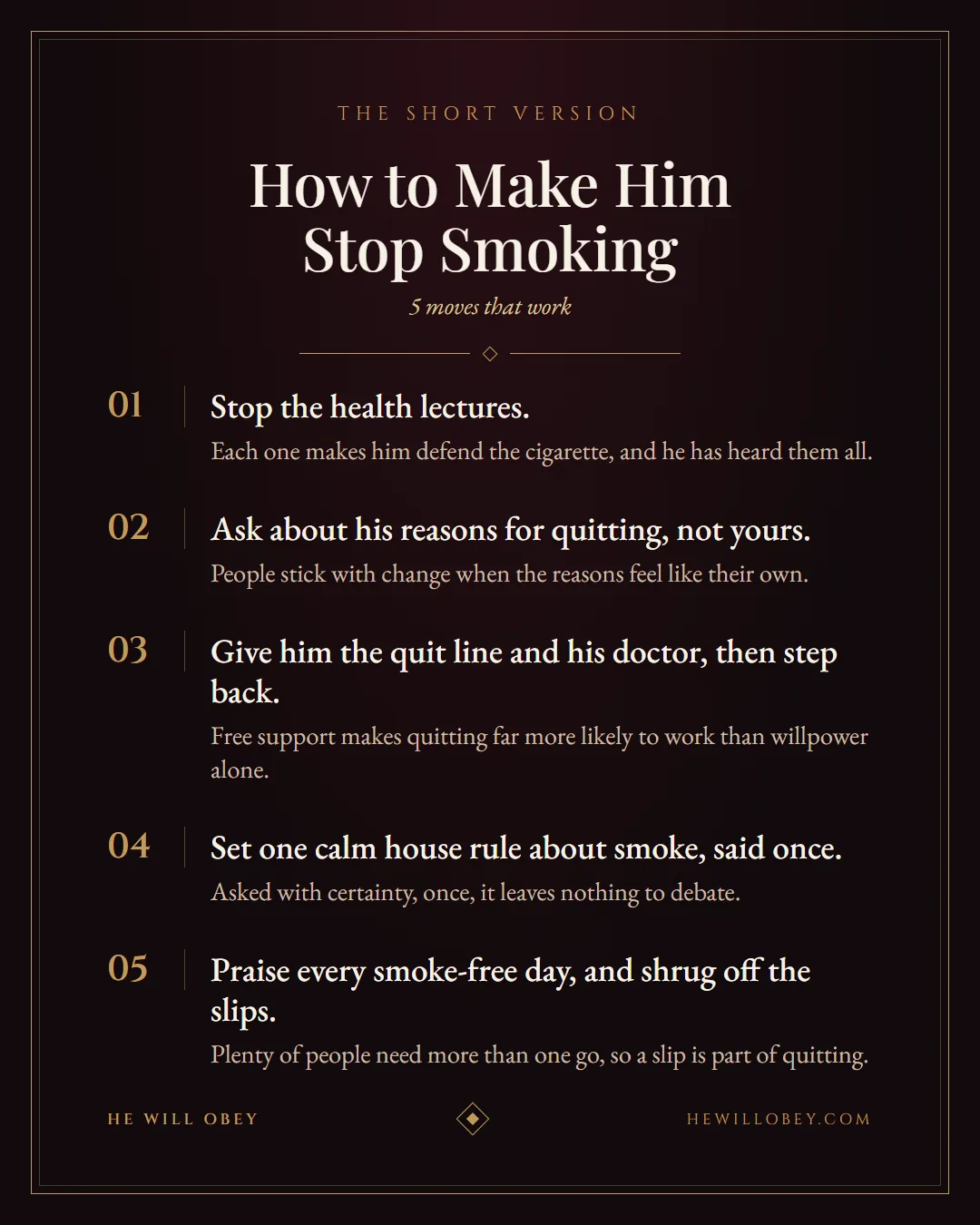
- Stop the health lectures. Each one makes him defend the cigarette, and he has heard them all.
- Ask about his reasons for quitting, not yours. People stick with change when the reasons feel like their own.
- Give him the quit line and his doctor, then step back. Free support makes quitting far more likely to work than willpower alone.
- Set one calm house rule about smoke, said once. Asked with certainty, once, it leaves nothing to debate.
- Praise every smoke-free day, and shrug off the slips. Plenty of people need more than one go, so a slip is part of quitting.
Why your warnings have not worked
You have shown him the picture on the packet. Told him about your grandad. Hidden the lighter. Once, you cried. He smoked on the balcony afterwards, alone, feeling like a child who had been told off.
He knows smoking is bad for him. Almost every smoker does. Information is not what he is short of. What he is short of is a reason to quit that belongs to him, and the help to get through the hard first weeks.
Every warning from you, however loving, puts you on one side and the cigarette on the other. He ends up defending smoking because he is defending his right to choose. The pillar on how to make him change explains why pushing produces pushback. With smoking, that pushback is very familiar.
The psychology: his reasons, not yours
Edward Deci and Richard Ryan built self-determination theory around one finding that keeps repeating: people stick with change when the reasons feel like their own, and drop it when the change feels imposed. They called the first kind autonomous motivation. Researchers have since applied it to quitting smoking, and the pattern holds. The reasons that last are the ones he owns.
Your fear for his lungs is real, and it is yours. His reason might be different. Wanting to run with his son without stopping. Being sick of standing outside in the rain at work. The money for the motorbike.
You will not guess it. You have to ask.
Then the job changes. You are not the person making him quit. You are the person helping him do the thing he wants.
How to make him stop smoking: the six steps
1. Stop the lectures. Tell him so, plainly, and mean it. "I'm going to stop going on about the smoking. It's your call, and I know you know." This takes the fight out of it, and often, oddly, he raises it himself within weeks.
2. Ask about his reasons, once. Pick a calm moment, not the morning after a coughing fit. "If you ever did pack it in, what would be the best part for you?" Listen. Do not add your own reasons to his list.
3. Make one house rule, and keep it. This is Law VII, the Law of the Velvet Command: ask with certainty, once. Smoking outside the house and out of the shared car is a fair standard, especially with children. "I want the house and the car smoke-free from now on. Outside is fine." No debate, no anger.
4. Hand him the help, then step back. Willpower alone is the hardest way to quit. Free support makes it much more likely to work. In the US, the national quit line is 1-800-QUIT-NOW (1-800-784-8669). In the UK, local NHS Stop Smoking Services are free, and the NHS Smokefree site lists them. His doctor or pharmacist can talk him through nicotine replacement and prescription options, and support combined with treatment gives him the best chance. Give him the number. Let him make the call.
5. Help him through the hard weeks. The first few weeks are often the hardest, and irritability and restlessness are common. Change the routines that went with the cigarette. If he always smoked after dinner, take a walk together instead. "Fancy a stroll round the block before the washing up?" Expect him to be short-tempered, and do not take every snap personally.
6. Praise every day, shrug off the slips. This is the spine, Law VIII, the Law of the Golden Word. "A whole week. I'm proud of you, and you smell like you again." When he slips, and plenty of people need more than one go, treat it as part of quitting, not a failure. "One bad day isn't the end. Start again tomorrow."
If you smoke too
If you both smoke, the best help you can give is to quit with him, or at least to stop smoking around him. Quitting as a pair can work well: same start date, same support, someone who understands the cravings at 10 p.m. If you are not ready, at least keep your cigarettes out of sight and smoke away from him while he tries. Asking him to quit while you light up beside him is asking a lot.
The trap: becoming the smoke police
The trap is policing. Sniffing his jacket. Counting the packets in the bin. Checking the car ashtray. Asking "have you had one today?" every evening.
It feels like support. To him it feels like probation. And the moment he feels watched, smoking becomes the one private thing he has, so he hides it rather than quitting. Now you have a man who still smokes and also lies about it.
Trust the process you have handed him. If he tells you he slipped, thank him for telling you. That honesty is worth more than any number of searches. The same pattern runs through how to make him stop snoring and how to make him lose weight: health habits change through support, not surveillance.
Related: how to make him stop drinking.
Frequently asked questions
How to make my husband quit smoking?
Stop the warnings, ask once what he would want from quitting, and agree a smoke-free home. Then give him the quit line number or suggest he books in with his doctor, and let him make the call. Praise every smoke-free day. If you have children, his reasons may be there, but let him name them.
How to make my boyfriend stop smoking?
You cannot make him, and nagging will push him to defend it. Tell him once how you feel about it, then ask what would make quitting worth it for him. Point him to free quit services and his doctor. If smoking is a dealbreaker for you, say so calmly, once, and let him decide. That is honest, not a threat.
How to make my partner quit smoking?
Make it their decision and then make the decision easier. Stop the lectures, ask about their own reasons, and hand them the free help: a quit line, a local stop-smoking service, a doctor or pharmacist. Keep your shared spaces smoke-free. Treat slips as a normal part of quitting, not proof it cannot be done.
How to make my man stop smoking?
Swap pressure for support. One calm conversation about his reasons, one house rule about smoke, and the phone number for a quit service. Then praise what he manages and ignore the slips. A man who feels backed is more likely to try again. A man who feels judged hides his cigarettes instead. The way to say it so he hears it is on how to make him listen to you.
Should I give him an ultimatum about smoking?
Only if you would really leave. An ultimatum you do not keep teaches him your words carry no weight. If smoking is a genuine dealbreaker, it is fair to say so once, calmly. Usually, a clear standard about your own space, such as no smoking indoors, works better than a threat about the relationship.
What if he switches to vaping instead?
Whether vaping is a sensible step toward quitting is a question for his doctor or stop-smoking adviser, and advice differs between countries. Do not turn it into a new fight. If he is using it to stop smoking, support the plan he agrees with his adviser.
How to make my husband stop smoking weed?
The same rule applies: you cannot make him, but you can stop the fight and ask about his own reasons. Set one calm house rule, like never around the kids or in the car. If it is daily and costing him work or sleep, it may be cannabis use disorder, and help exists. In the US, SAMHSA's free helpline is 1-800-662-4357. In the UK, FRANK is 0300 123 6600.
From the Codex
The Law behind this
In He Will Obey, this is Law VIII, the Law of the Golden Word: praise is the strongest reinforcement there is. A man who hears that his smoke-free week was noticed has a reason to make it two. The book gives you the full Law, the Golden Word scripts, and the Velvet Command line for setting a standard once.
He was never taken. He was chosen, and he knows it.
Sources
- self-determination theory doi.org
- NHS Stop Smoking Services www.nhs.uk
- SAMHSA www.samhsa.gov