How to Make Him Treat You Better (and Put In More Effort)
A man treats you the way it has been easy and pleasant to treat you. To make him treat you better, ask for one specific change instead of better in general, stop doing the half of his job you have been quietly covering, and praise every step up the same day he takes it. Complaints teach him to avoid you. Praise teaches him what works.
On this page
- Short Version of Getting Better Treatment From Him
- Why he treats you like this now
- The psychology: the ledger nobody shows
- How to make him treat you better: the five steps
- How to make him put more effort into the relationship
- How to make my boyfriend nicer to me
- When "treating me badly" is something else
- The trap
- Frequently asked questions
Short Version of Getting Better Treatment From Him
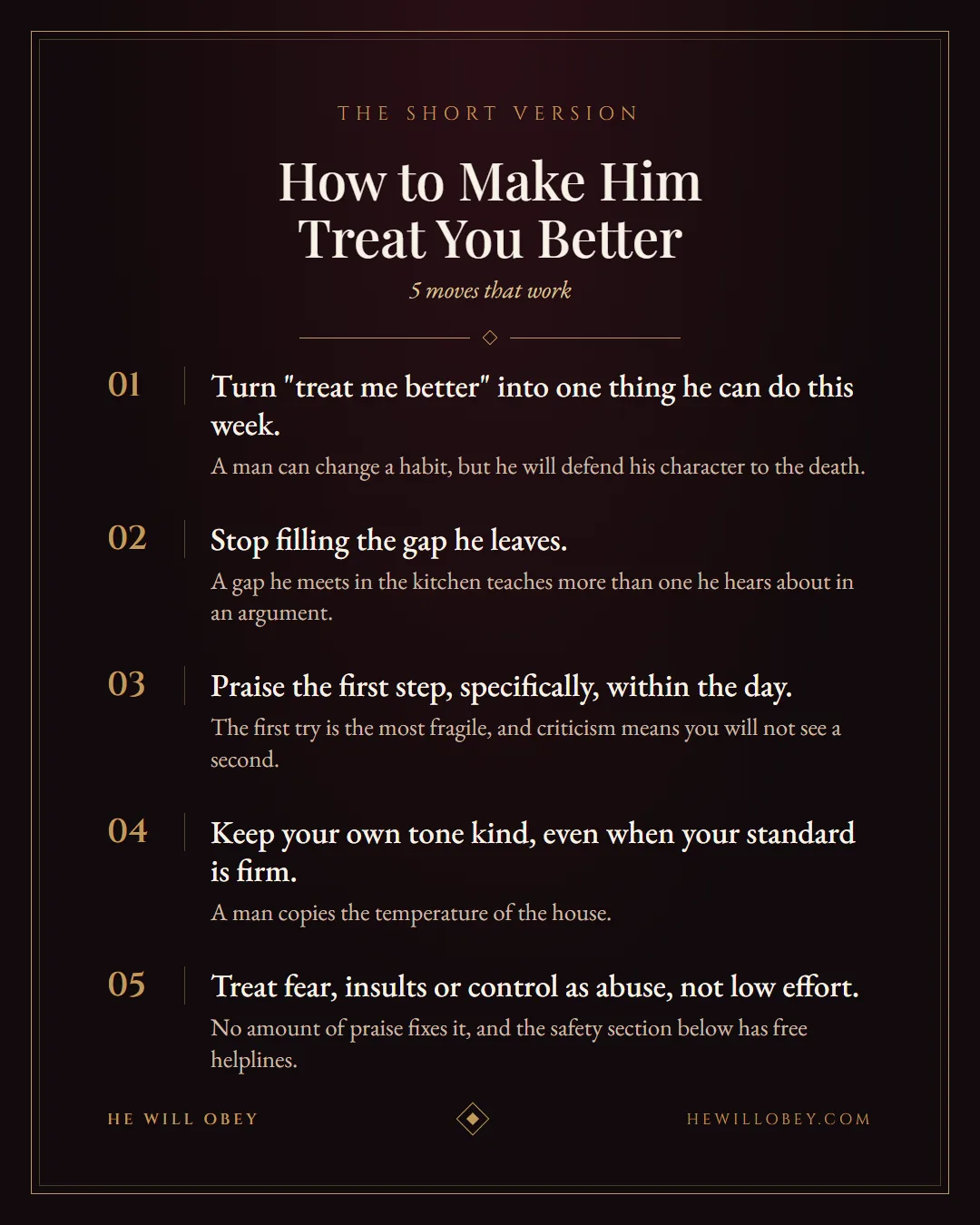
- Turn "treat me better" into one thing he can do this week. A man can change a habit, but he will defend his character to the death.
- Stop filling the gap he leaves. A gap he meets in the kitchen teaches more than one he hears about in an argument.
- Praise the first step, specifically, within the day. The first try is the most fragile, and criticism means you will not see a second.
- Keep your own tone kind, even when your standard is firm. A man copies the temperature of the house.
- Treat fear, insults or control as abuse, not low effort. No amount of praise fixes it, and the safety section below has free helplines.
Why he treats you like this now
At the start he planned the dates, asked about your day and noticed the new earrings. Now you plan everything, he scrolls while you talk, and the last time you were sick he asked what was for dinner.
You have told him. "You don't treat me like you used to." He hears an accusation with no instructions, gets defensive, and you end the evening apologizing.
Two things happened, slowly. You did more to keep things warm, and he did less, because the warmth arrived either way. And your requests grew vaguer as they grew more frustrated, until they became verdicts on his character.
A man can change a habit. He will defend his character to the death. The general rules are in how to make him change. This page is the daily treatment: effort, tone, the small courtesies that slipped.
The psychology: the ledger nobody shows
Elaine Hatfield and her colleagues built equity theory around a simple idea: people feel best in relationships where what they give and what they get seem roughly fair. The person getting less feels resentful. The person getting more feels a mild discomfort.
You feel the imbalance every day, because you carry it. He feels it faintly, and the easiest way to manage a faint discomfort is not to look at it. Your list of grievances forces him to look all at once, so he defends instead of rebalancing.
The fix is to make the ledger visible without reading it aloud. Do less of what he should be doing, so the gap is something he meets in the kitchen, not something he hears about in an argument. Then reward him heavily for every move back toward fair. In He Will Obey this is Law VIII, the Law of the Golden Word, and on effort it works far faster than criticism ever has.
How to make him treat you better: the five steps
1. Translate "better" into a task. What, specifically, would make you feel well treated this week? A call on his lunch break. Him booking Friday. "I'd love it if you planned one date a month. Just you, start to finish."
2. Ask once, at a calm moment. Not mid-argument. A quiet Sunday, a short sentence, no history. Law III, the Law of the Throne, means you state the standard and stop. You do not prosecute it.
3. Stop covering the gap. If he has not booked Friday by Thursday, you do not book it. You make your own plans. "No plan for tonight? No problem, I'm seeing Tasha." The empty evening teaches him more than a speech.
4. Praise the first step, out loud. Same bistro as always? Praise it anyway. "You planned tonight and I didn't have to think. That felt lovely." The first try is the most fragile one. Criticize it and you will not see a second.
5. Match tone with tone. If you speak to him with contempt, he will treat you with contempt and feel justified. Keep your voice warm even when your standard is firm.
How to make him put more effort into the relationship
Effort follows need and reward. He does not need to try, because you try for both of you. And when he does try, it is often met with "finally."
So split the work honestly. Pick two things he used to do and has stopped: planning, texting during the day, organizing time with your friends. Hand them back with one sentence each and then leave them alone. "I'm not going to plan our weekends anymore. I'd love you to take that over." Some weeks will be empty. Let them.
When he steps up his game, even clumsily, make a fuss the right size. A specific line and a smile. Men step up for women who notice the step. If you are trying to move from effort to genuine priority, the steps on how to make him prioritize you take this further.
How to make my boyfriend nicer to me
"Be nicer" is the vaguest request a man can receive, so make it concrete. Is it his tone when he is tired? The jokes at your expense in front of friends? The sigh when you ask for something?
Pick the one that hurts most and name it once with what you want instead. "When you sigh before helping, I feel like a chore. A plain yes or no is fine with me." Then notice the first time he gets it right.
If the jokes at your expense are the issue, that is a respect question, and it has its own method in how to make him respect you.
When "treating me badly" is something else
If he calls you names, controls your money or your phone, decides who you can see, frightens you when he is angry, or has hurt you physically, that is not a man who needs to step up. That is abuse, and no amount of praise or standard-setting fixes it. It is not your fault, and you do not have to be certain before you ask for help.
Talk to someone trained for exactly this. In the US, the National Domestic Violence Hotline: 1-800-799-7233. In the UK, the National Domestic Abuse Helpline: 0808 2000 247. Both are free and confidential, and both help people who are unsure.
The trap
The trap is the scoreboard. You start keeping count of every effort you make and every one he skips, and eventually you read the score out loud. He hears a bill. Men will pay a bill once, resentfully, and then avoid the woman who sends it.
The second trap is praise with a sting. "Wow, look at you, finally booking something." That "finally" erases the praise. Keep praise clean and keep the standard for a separate, calm moment.
Frequently asked questions
How to make my husband treat me better?
Pick the one change that would matter most this month and ask for it at a quiet moment, in a sentence. Stop doing the matching half of the work yourself. Thank him every time he does it. Husbands slip into the minimum because the minimum has been enough.
How to make my husband less selfish?
Ask for specific give-and-take rather than a change of character. "You choose Saturday, I choose Sunday." Stop automatically giving up your preference to keep the peace, because a man surrounded by yeses never learns he is taking. Praise him when he puts you first, by name and on the day.
How to make him act right?
Decide what "right" means in behavior you could film: calling when he is late, no insults in arguments. Say it once. Then act on it the first time he crosses it, calmly. A man acts right where acting wrong has a real, predictable cost and acting right gets noticed.
How to make my boyfriend be nice to me?
Tell him exactly what nice looks like to you, because his version may be different. Then be nice back, specifically, and notice it out loud when he gets it right. If he is nice only when he wants something, or cruel when you are alone, take that seriously and talk to a friend or a helpline.
How to make my boyfriend make more effort?
Stop making the effort he should be making. Plan nothing for two weeks and see what he plans. Tell him once what effort means to you. When he does make more effort, reward it warmly. A boyfriend who does nothing even after the gap is obvious has answered the question.
From the Codex
The Law behind this
In He Will Obey, this is Law VIII, the Law of the Golden Word: praise is the strongest reinforcement there is, and a man repeats whatever earns him your warm, specific notice. Ask once, stop covering, and reward the step. The book gives you the Golden Word scripts that do not sound like a parent, the seven-day ritual for handing back the work, and the lines for the week he tests whether you meant it.
He was never taken. He was chosen, and he knows it.