How to Make Him Understand You (and Make Him Feel Heard)
To make him understand you, describe one specific moment instead of a general feeling, tell him what you want him to do with it, and ask him to say back what he heard before you add anything more. To make him feel heard, do the same for him in reverse. Understanding is a trade, and it starts small.
On this page
Short Version of Being Understood by Him
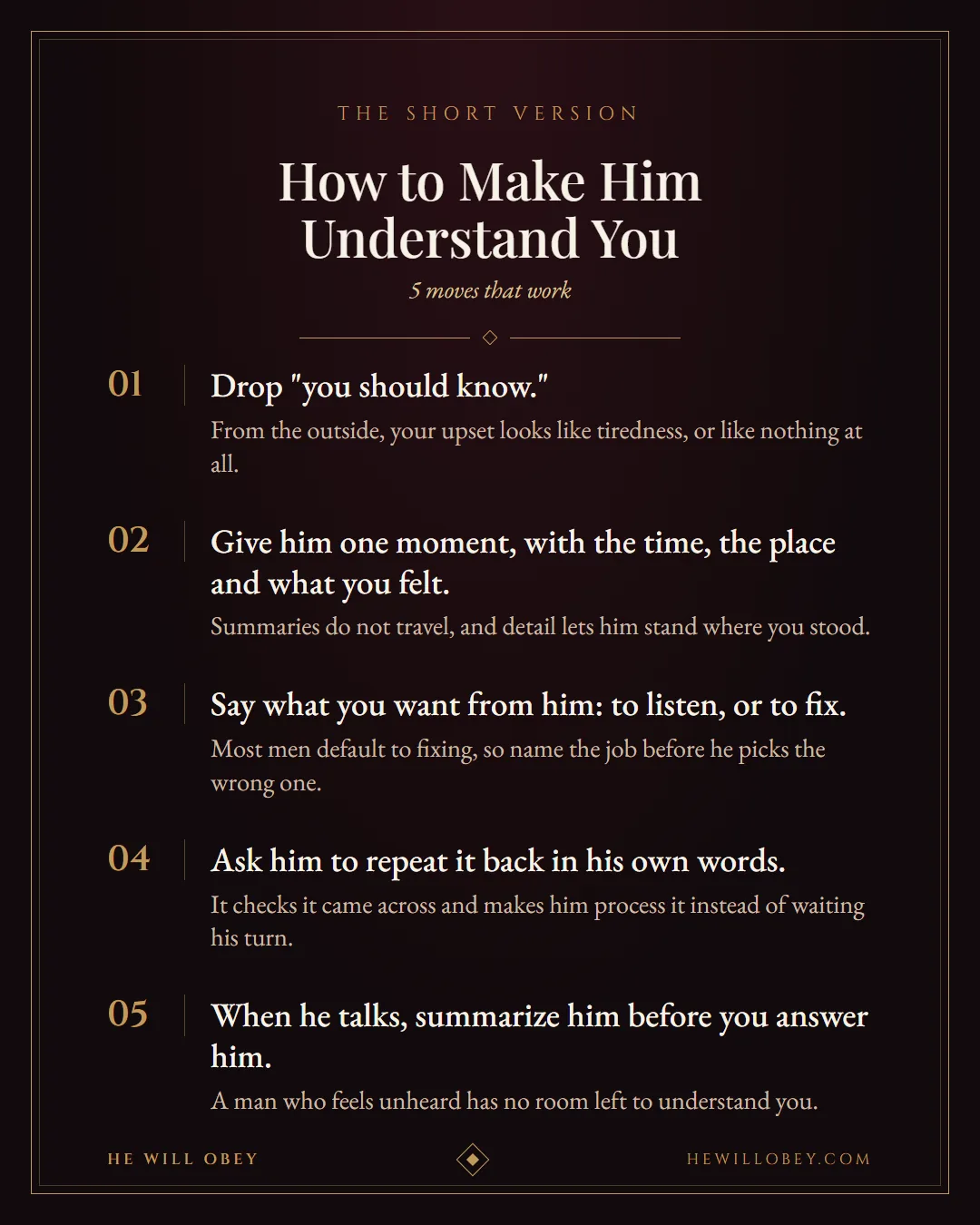
- Drop "you should know." From the outside, your upset looks like tiredness, or like nothing at all.
- Give him one moment, with the time, the place and what you felt. Summaries do not travel, and detail lets him stand where you stood.
- Say what you want from him: to listen, or to fix. Most men default to fixing, so name the job before he picks the wrong one.
- Ask him to repeat it back in his own words. It checks it came across and makes him process it instead of waiting his turn.
- When he talks, summarize him before you answer him. A man who feels unheard has no room left to understand you.
Why he doesn't understand you
You have explained it. Many times. The way his mother's comments land. Why you need the evening alone after a long week.
He nods, and two weeks later he does the same thing again, and you think: he does not listen. Or worse: he does not care.
Usually neither is true. You have been explaining in summaries, and summaries do not travel. "I feel unsupported" is a conclusion you reached after a hundred small moments he never saw from inside.
You hand him the conclusion and expect him to rebuild the hundred moments. He cannot. So he defends himself against the conclusion instead.
This is the far side of the work in the guide to making him trust you. Trust is him feeling safe with you. Understanding is him being able to see you.
The psychology: the illusion of transparency
Thomas Gilovich, Kenneth Savitsky and Victoria Husted Medvec studied what they called the illusion of transparency: people believe their inner states are far more visible than they are. Participants who told a lie assumed observers could see it. Mostly, the observers could not.
Closeness makes it worse. Savitsky and colleagues later found what they called a closeness-communication bias: we overestimate how well we get across to people we know well, precisely because we know them. "He should know I'm upset" feels obvious from inside. From outside, your upset looks a lot like tiredness, or nothing at all.
So the first step to being understood is accepting how little shows. Not because he is unobservant. Because nobody is as observant as we feel they should be.
The answer is in He Will Obey as Law VII, the Law of the Velvet Command: say what you want warmly, briefly, with certainty. The Velvet Command is usually taught for requests. It works just as well for being understood, because understanding is a request: see this.
How to make him understand you: five steps
1. Retire "you should know." Say it to yourself once, and let it go. Every time you expect him to read you, you set up a test he will fail and a resentment you will keep. "I'm going to tell you something you couldn't have known, because I never said it."
2. Give him one moment, not a summary. Time, place, what happened, what it felt like. Detail is what lets him stand where you stood. "On Sunday, when your mom said the kitchen 'had potential,' I went hot from the neck up and spent the afternoon feeling like a guest in my own house."
3. Tell him what you want done with it. Listening and fixing are different jobs, and most men default to fixing. Name the job before he picks the wrong one. "I don't need you to talk to her. I just need you to know that it stung."
4. Ask him to say it back. Not as a test. As a check. It also makes him process it rather than wait for his turn. "Can you tell me what you heard? I want to know it came across."
5. Stop at one point. This is Law X, the Law of the Single Word: no over-explaining. Leave out the related grievances that came to mind while you were talking. One moment understood beats five half-heard. "That's it. That's the whole thing."
How to make him feel heard
This half decides whether the first half works. A man who feels unheard has no room left to understand you.
Howard Markman and Scott Stanley, two psychologists who study couples, developed a simple structure called the speaker-listener technique. One person holds the floor. The other paraphrases what they heard, without adding their own view. Only when the speaker agrees the paraphrase is right does the floor switch.
It feels stiff. It works, because both people have to prove they heard before they answer.
At home you need only its core move: summarize him before you respond to him. When he tells you about the boss who took credit for his work, do not jump to advice or to your own similar story.
"So he presented your numbers in the meeting like they were his, and nobody said anything. That's infuriating."
Then wait. If you got it right, he will usually say more. If you got it wrong, he will correct you, and that correction is a gift.
Men often stop talking because they feel she is already composing her reply. Proving you were not is what makes him feel heard. If he has gone quiet altogether, the method for how to make him talk to you starts one step earlier.
The trap
The trap is the explanation spiral.
He does not understand the first time, so you explain again. Longer, with more feeling in your voice. Then again. Each round, you feel less understood and he feels more lectured. By the end he is agreeing just to make it stop, and you can tell, and that is worse than not being understood at all.
The second trap is confusing understanding with agreement. He can understand perfectly why his comment hurt you and still think you are being a bit sensitive. That is allowed. Understanding is the goal.
If you hold out for agreement as well, you will keep explaining long after he understood, and he will learn that understanding you never ends. Being listened to on everyday requests is a separate skill; how to make him listen to you covers that one.
Frequently asked questions
How to make my boyfriend understand me?
Give him the inside view of one specific moment, not your general pattern. Boyfriends are still learning how you work, so "I need space after a long day" means little until they have seen it. Describe the last time it happened and what helped. Then ask him what he took from it. Correct gently, once.
How to make my husband understand me?
Pick a calm moment, not the middle of the problem. Husbands often hear a recurring complaint as background noise, because they have heard its summary for years. Give him a fresh, specific moment instead, with a clear request attached. Then ask him to say it back. A husband who can repeat it accurately has understood it, often for the first time.
How to make my partner understand me?
Tell him what you need from the conversation before it starts. "I want to tell you something and I just need you to listen" prevents the fix-it reflex. Then describe one concrete moment. Partners understand best when they know their job in advance and are given detail they can picture. Summaries invite debate. Pictures invite empathy.
How to make my boyfriend feel heard?
Summarise what he said before you say anything of your own. "So it's not the job itself, it's that you never get credit." If he says yes, ask one more question. If he says no, let him correct you. Boyfriends often feel unheard because their partner jumps to advice, so hold back the advice until he asks for it.
How to make my husband feel heard?
Give him your full attention for ten minutes with the phone face down, and repeat back the heart of what he says. Husbands in long marriages often feel their wife has already decided what they think. Prove you have not. Ask "what else?" before you respond. Then respond to what he actually said, not what you expected.
How to make my partner feel heard?
Use the core of the speaker-listener technique: one person talks, the other paraphrases, and the floor only switches when the speaker agrees the paraphrase is right. It feels clumsy at first. It works because it stops both of you from answering a point that was never made. Try it once on a small topic before a big one.
From the Codex
The Law behind this
In He Will Obey, this is Law VII, the Law of the Velvet Command: ask for what you want with warmth and certainty. Being understood is a request like any other, and it lands the same way, as one clear sentence rather than a long case. The book's ritual for this Law: one plain request a day, then silence until he answers. For understanding, the request is "Tell me what you heard."
He was never taken. He was chosen, and he knows it.